
Agadir – The latest performance update from the African Airlines Association (AFRAA) has ranked Casablanca’s Mohammed V International Airport and Marrakech Menara International Airport among Africa’s 10 largest airports in terms of seat capacity in August 2026.
The two Moroccan airports featured in AFRAA’s continental ranking as African airports continued to expand their capacity amid rising demand for national and international air travel.
AFRAA reported that total seat capacity across Africa increased by 8.8% in August compared with the same month in 2025. Seat availability on intra-African routes also grew by 10.5%, driven by network expansion, new routes, and the deployment of larger aircraft.
The ranking places Morocco among the African countries with major airport hubs supporting the continent’s expanding air connectivity.
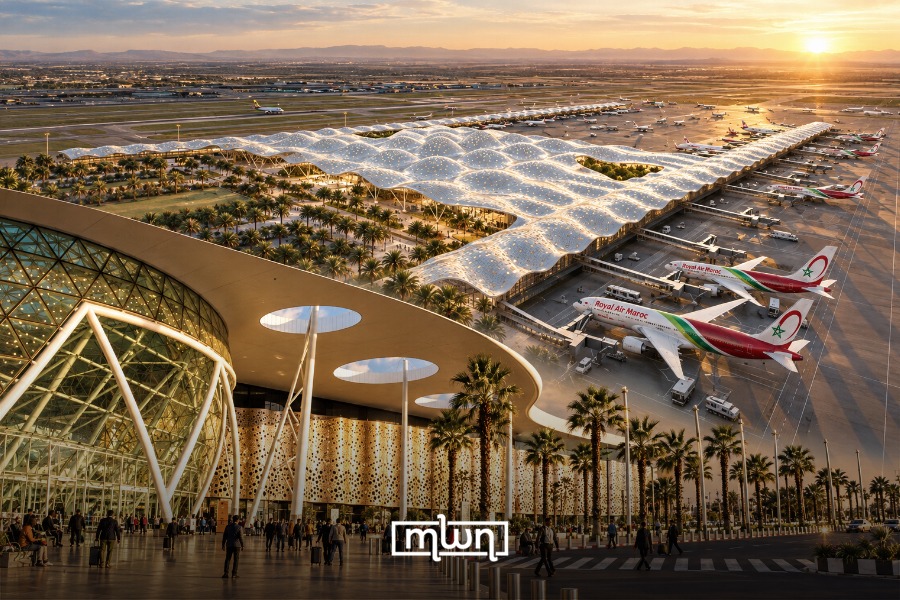
Casablanca’s Mohammed V International Airport serves as one of Morocco’s main international gateways, while Marrakech Menara plays a major role in the country’s tourism-driven air traffic.
The broader growth in Morocco’s aviation sector also appears in passenger traffic figures. Moroccan airports handled more than 22.28 million passengers during the first seven months of 2026, up 8.77% from the same period a year earlier, according to the National Airports Office (ONDA).
Casablanca Mohammed V remained Morocco’s busiest airport, receiving 6,953,695 passengers between January and July. Marrakech-Menara followed with 6,407,303 passengers.
Read also: Morocco’s Airports Handle Over 22 Million Passengers in First Seven Months of 2026
Morocco is expanding its airport infrastructure to accommodate continued growth and prepare for major international events, including the 2030 FIFA World Cup, which the country will co-host with Spain and Portugal.
Under its “Airports 2030” strategy, Morocco plans to increase its nationwide airport capacity from around 34 million to 80 million passengers annually by 2030.
AFRAA’s data also showed that African airlines accounted for 47.2% of international seat capacity in August, compared with 52.8% for non-African carriers. For intercontinental services, African airlines held a 62.4% share of capacity, while non-African airlines accounted for 37.6%.
North Africa accounted for the largest share of Africa’s overall seat capacity in August, with 41.9%, followed by Eastern Africa at 22.7% and Southern Africa at 18.3%, according to AFRAA.
