


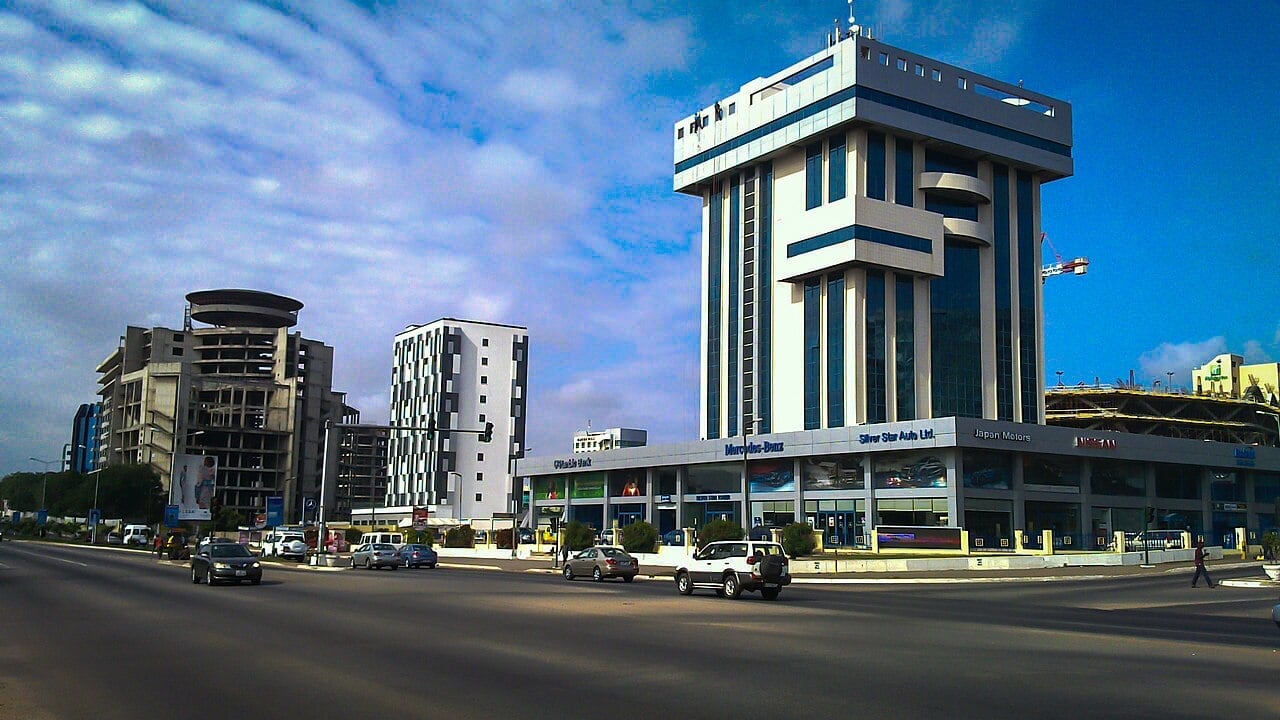
A few kilometres around Accra International Airport, a second capital is quietly being built. Not a political one, though Jubilee House – the seat of government – sits nearby. This is the capital of deals.
The shift is visible from the road: Accra Marriott Hotel, Marina Mall, Holiday Inn, Ibis Styles, airline offices, diplomatic missions, Telecel’s corporate presence and a rising belt of apartments around Airport Residential, Cantonments, Roman Ridge and Airport West. Ghana Airports Company has long promoted Airport City on the idea that airports are no longer just terminals, but engines of trade, jobs, and investment. In Accra, that theory is becoming concrete.
“The effective demand is overtaking the useful planning of that area as even a security zone,” Nii Oto Cofie, an urban planner with the state-owned Physical Planning Department, tells The Africa Report. “Those who are around are people who can pay.”
The new Accra
That sentence captures the new Accra. The airport enclave has become a market shaped by proximity, status, and protection. It is close to the runway, close to the presidency, close to embassies, close to East Legon and Cantonments, and far enough from the choking disorder of older commercial centres to feel like a different country.
For economist Daniel Anim Amartey-Prempeh, the logic is clear. The airport area is “a pivotal strategic point for businesses to relocate” because executives are close to the business action without “zooming into the heart of the city”. In a capital where traffic can turn short distances into lost hours, time itself has become a class marker.
Accra International Airport handled more than 3.6 million passengers in 2025, according to aviation statistics cited by the Ghana Civil Aviation Authority. Terminal 3 has strengthened the airport’s role as Ghana’s gateway. Around it, the city has followed the money.
In an announcement by Ghana Airports on Thursday, Terminal 3 car park is now closed in order to “facilitate the construction of a seven-storey multi-purpose car park and Airport Hotel Complex.”
This is how new business districts are born: first through infrastructure, then through confidence, then through imitation. Nairobi has Upper Hill. Lagos has Victoria Island. Johannesburg has Sandton. Accra now has its airport corridor.
Older centre issues
These districts often reveal the weakness of the wider city, rising because older centres have become difficult to use. In Accra Central, Okaishie, Makola, and parts of Adabraka, congestion and ageing infrastructure constrain formal investment. The airport zone offers a cleaner proposition: better roads, safer addresses, easier access, higher rents, and global signals.
Samuel Amegayibor, executive director of the Ghana Real Estate Developers Association, says the premium is not accidental. “The airport residential area has become the top most prime area,” he tells The Africa Report, citing proximity to the airport, security expectations among diplomats and expatriates, and “the best of layouts, infrastructure, all that you need”.
Yet this elite corridor is also a planning failure in slow motion. Airport Residential was not originally designed to become an office district. Amegayibor warns that too many homes have been converted into commercial premises. “We need to up our regulatory enforcement,” he says. “What is supposed to be for residential is used for residential.”
The strain is already familiar: traffic on roads not planned for such intensity, pressure on water and electricity, and a skyline rising beside one of the country’s most sensitive security assets. Cofie goes further, arguing that if the pressure continues, Ghana may have to revisit an idea once considered drastic: relocating the airport.
Who is this city for?
There is also the social question. Who is this city for? Luxury towers such as Villagio, Mirage, The Elizabeth, and Clifton serve diplomats, expatriates, diaspora investors, multinational staff, and high-earning Ghanaians.
“It will be difficult for a typical Ghanaian working in Ghana to raise that kind of money to buy these properties,” Amegayibor says.
That does not make the airport economy illegitimate. It makes it politically revealing. Ghana needs competitive districts capable of attracting capital and conferences. But if opportunity concentrates in a few square kilometres, the rest of the city becomes an afterthought.
Economist Amartey-Prempeh with the Public Initiative for Economic Development sees the airport’s rise as “a step in the right direction”, but adds a warning: “We shouldn’t overly concentrate in that particular area. We should also be discovering new areas.”
He argues that Kwame Nkrumah Circle and other older commercial corridors could be redeveloped to share the value now clustering around the airport.
That may be Accra’s real test. The issue is not whether Airport City should grow. It is whether Ghana can build more than one version of modernity. Without stronger planning, transport links, drainage, enforcement and deliberate renewal of older districts, the airport enclave could become less a national gateway than a gated economic future. A new Ghana is emerging around the runway. The danger is that most Ghanaians may only pass through it.
