
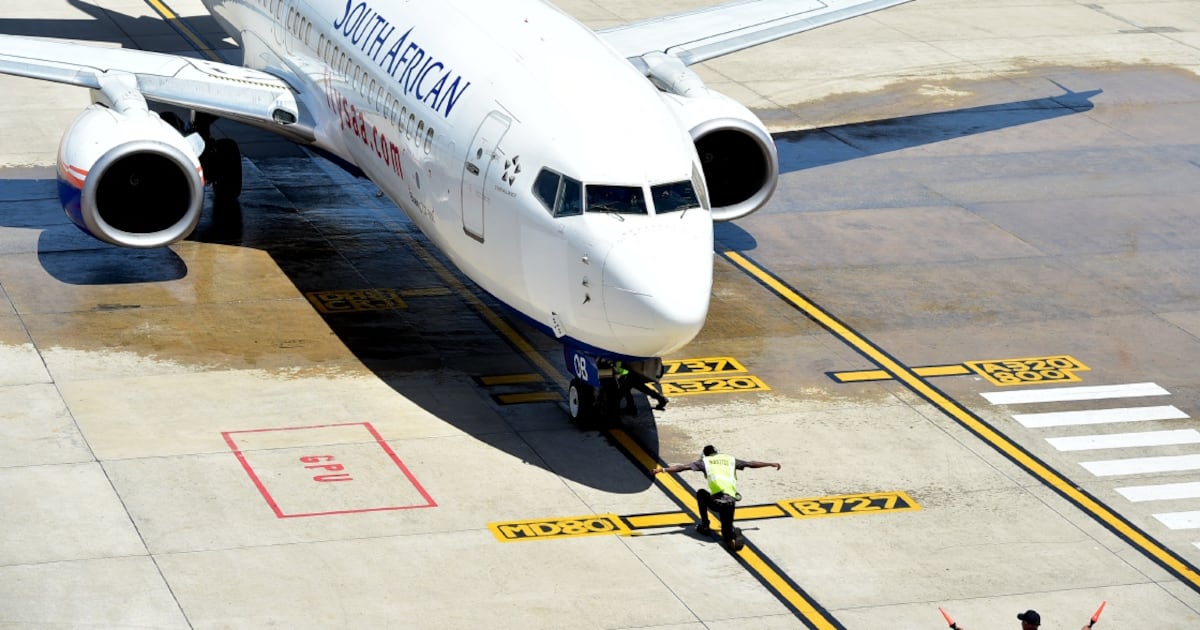
Africa’s aviation industry can no longer afford the divide between strategy and action, said Airlines Association of Southern Africa (AASA) CEO Aaron Munetsi.
Munetsi has called on governments, regulators and stakeholders to stop debating, take ownership and deliver decisive, measurable progress across the continent.
AASA represents most of the airlines in the SA Development Community on matters of common interest such as government policies, legislation, regulations, operational efficiency, safety, security, taxes and charges affecting its members’ sustainability.
“The [aviation] industry and governments have spent decades discussing the challenges facing African aviation and commissioned consultants to provide expensive strategies — only to leave them unimplemented. Now it is time to make the difficult decisions and execute them,” Munetsi said at AASA’s annual general assembly in Mauritius at the weekend.
“We need to design aviation around reasonably priced flights that are on time, with convenient business-oriented schedules that can be purchased using frictionless digital payments compatible with mobile money, offering products suited to traders as well as tourists, and using efficient airports and border processes.”
AASA proposes the following urgent, measurable action items to stimulate sustainable growth in Africa’s passenger and air cargo sector:
- Safety must be nonnegotiable and should be underscored by investments in resources, effective oversight, training and zero tolerance for shortcuts.
- Costs, aviation-related taxes, fees and charges need to be contained and the introduction of new ones avoided.
- Airports and other aviation infrastructure need to be modernised and maintained for efficiency and affordable user-charges applied for those services.
- Anticompetitive and protectionist restrictions on market access need to be eliminated, and the Single African Air Transport Market (SAATM) needs to be implemented. SAATM is an initiative of the African Union that aims to liberalise the African aviation industry. AASA says that such liberalisation must move beyond declarations and become a practical reality.
- Regulations should be standardised, licences recognised and procedures across borders harmonised.
In his address at the assembly, Kamil Alawadhi, regional vice-president for Africa and Middle East of the International Air Transport Association (Iata), said Africa is expected to be one of the fastest-growing aviation markets globally.
Yet, challenges remain. For example, jet fuel prices rose sharply, averaging $158 per barrel in the second quarter this year, 27% higher than in the first quarter.
“Demand is there. But translating that demand into financially sustainable connectivity remains difficult. Even before the latest fuel-price pressures, African airlines were forecast to earn only about $200m in 2026, equivalent to about $1.30 per passenger.
“And African carriers already contend with fuel prices around 17% above the global average, taxes and charges 12% to 15% higher, and air navigation charges around 10% higher,” said Alawadhi. “That leaves airlines with very little room to absorb additional costs. And this is where policy matters. Stop adding to the cost of connectivity.”
Iata is calling on African governments to participate in the UN negotiations to preserve the established residence-based taxation principles for international aviation and avoid creating multiple or competing taxing rights.
Demand is there. But translating that demand into financially sustainable connectivity remains difficult. Even before the latest fuel-price pressures, African airlines were forecast to earn only about $200m in 2026, equivalent to about $1.30 per passenger.
— Kamil Alawadhi, regional Iata vice-president for Africa and Middle East
“The objective should be to strengthen international tax co-operation without undermining the framework that has enabled global aviation connectivity to develop,” said Alawadhi.
He also raised the issue of safety, as the accident rate in Africa remains several times higher than the global average. One of the biggest challenges is accident investigation and reporting. For example, in 2020-25, only 16% of accident reports in Africa were completed and published in accordance with requirements.
Through its Focus Africa initiative, Iata continues to work with partners through the collaborative aviation safety improvement programme (Casip) to address priorities including runway safety and safety management systems.
Business Day
