


The global aviation industry — including Africa’s rapidly growing sector — is struggling to cope with the economic fallout from the Iran war.
One of the most immediate pressures comes from jet fuel costs, which make up a significant portion of airline operating expenses.
Jet fuel, a kerosene‑based product refined from crude oil, is the primary fuel used by airlines.
However, disruptions linked to the Iran war have caused prices to double in some markets, leading to supply shortages.
“The impact is that it has affected how much African carriers purchase aviation fuel for their operations,” Dominick Andoh, managing partner of AviationGhana, an online aviation news portal, told DW.
Concerns over energy security have pushed up global oil prices.
In early trading on Wednesday, Brent crude oil was trading at close to $98 a barrel — up more than 30% since the war started at the end of February, news agency Reuters reported.
Analysts attribute the increase to fears that a fragile ceasefire between the United States and Iran could collapse, especially after the US seized an Iranian cargo ship and shipping traffic through the Strait of Hormuz remained largely halted.
Andoh noted that the spike in fuel prices has inevitably been passed on to passengers.
“The prices of tickets have gone up,” he told DW.
“If you look at the fuel surcharge margins for the tickets that have been sold since the war broke out, especially in April, the fuel surcharges have gone up by various percentages.”
Flight disruptions add to financial losses
The severity of the crisis has raised alarms among African business leaders.
“The majority of African airlines won’t be able to survive,” the current spike in fuel costs, Nigerian billionaire Aliko Dangote, owner of the Dangote refinery near Lagos, told an audience at the Semafor World Economy summit in Washington, D.C. on Monday.
Beyond fuel costs, airspace restrictions around Gulf countries have forced airlines to reroute or cancel flights, pushing operational costs even higher and reducing route efficiency. These disruptions have also contributed to higher ticket prices.
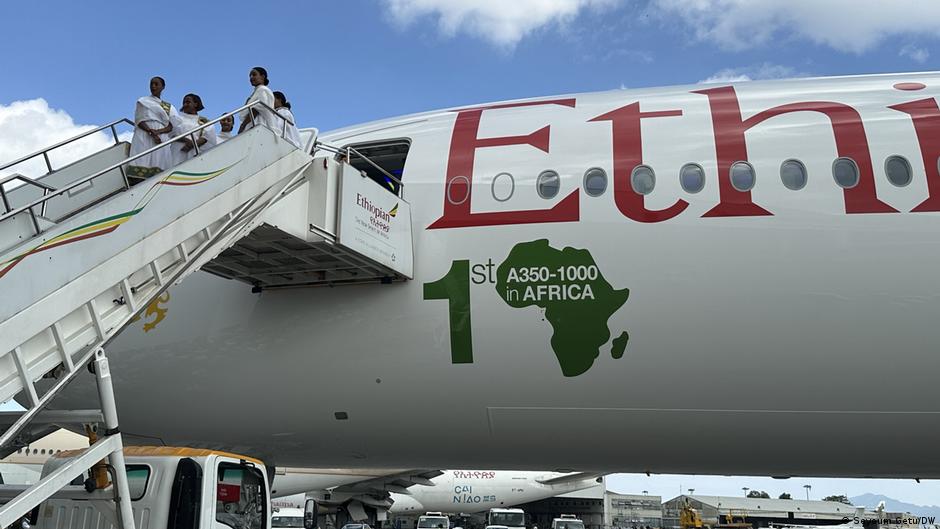
Ethiopian Airlines is among the hardest hit. In March, airline officials revealed that the carrier was losing about $137 million (€117 million) each week as a direct result of the crisis.
“The airline has canceled more than 100 flights a week, with some destinations previously operating up to three flights daily, and we have lost about $137 million in a week,” Lemma Yadhecha, the airline’s business manager, told local media.
Last week’s ceasefire announcement briefly raised hopes within the aviation industry that conditions would improve. However, the optimism was short‑lived amid fears the fragile agreement between the US and Iran could unravel.
African airlines turn to new survival strategies
In response to mounting challenges, some African airlines are adopting alternative strategies to keep operations running.
Kenya Airways, for instance, says it is rerouting more European travelers through its Nairobi hub rather than traditional Gulf transit points.
“We took advantage of the current situation and mainly re-routed a lot of customers from Europe. Instead of rerouting through the Gulf, they are back to re-route through Kenya, through our hub in Nairobi,” Kenya Airways CEO George Kamal told journalists.
Despite the turbulence, Andoh believes African aviation can weather the storm if airlines take preventive measures.
“What airlines can do is probably stock up more aviation fuel; that is if it is available. Probably hedge against pricing so that if the war drags on, they can have some fuel to survive,” Andoh said.
But the head of the IATA airline trade association, Willie Walsh, cautioned that if the Strait of Hormuz were to reopen and remain open, “it will still take a period of months to get back to where supply needs to be, given the disruption to the refining capacity in the Middle East, which is a critical part of the global supply of refined products.”
“And not just jet fuel, for the other products as well,” Walsh told journalists. “So it will probably take months.”
Tourism sector feels the ripple effects
The aviation crisis has also spilled over into tourism, an industry heavily dependent on air travel.
In South Africa, tour operators like Emraan Roode, a Cape Town–based tour operator, say cancellations and uncertainty are already affecting livelihoods.
“Cape Town is nominated one of the best places in the world for travelers to come and visit, and due to the war, Cape Town as a whole is suffering as well. I’m basically talking about the tourism industry, and a lot of the tour guides and tour companies are suffering as well,” Roode told Reuters.
Flight cancellations linked to Middle East routes have also affected businesses that rely on repeat international clients.
“I’ve lost between 350,000 and 500,000 rands ($21,000-$30,000) over the past few months due to the war in the Middle East alone. This has had a direct impact on my business, especially because many of these regular returning clients haven’t made any plans this year due to uncertainty,” Roode stressed.
Andoh, however, remains confident that both aviation and tourism will eventually recover.
“The aviation sector, the tourism sector, would remain in business,” he told DW. “If anything at all, COVID-19 proved that the tourism and aviation sectors are very resilient. People would still travel.”
Edited by: Keith Walker
