
Chinese state-owned firms are already among the contenders for major construction contracts on the four-runway airport, adding to Beijing’s long-standing dominance in Ethiopia’s infrastructure sector through investments in railways, industrial parks and transport networks.
Washington is now pushing to ensure American companies also secure a place in a project expected to reshape African aviation.
Reuters reported that U.S. Deputy Assistant Secretary of Commerce for the Middle East and Africa, Mark Mitchell, said at the Africa Logistics and Communications Symposium in Addis Ababa that Washington was “closely engaged in pushing to secure U.S. participation” in the airport project.
Mitchell said he had held discussions with Ethiopian Airlines officials but did not specify the role American companies would play.
He noted, however, that U.S. involvement could translate into additional Boeing aircraft powered by GE Aerospace engines, further strengthening commercial ties between the airline and American manufacturers.
The comments follow Ethiopian Airlines’ agreement in April to purchase six additional Boeing 787-9 Dreamliners, adding to an existing order of 20 aircraft.
Africa’s next aviation superhub
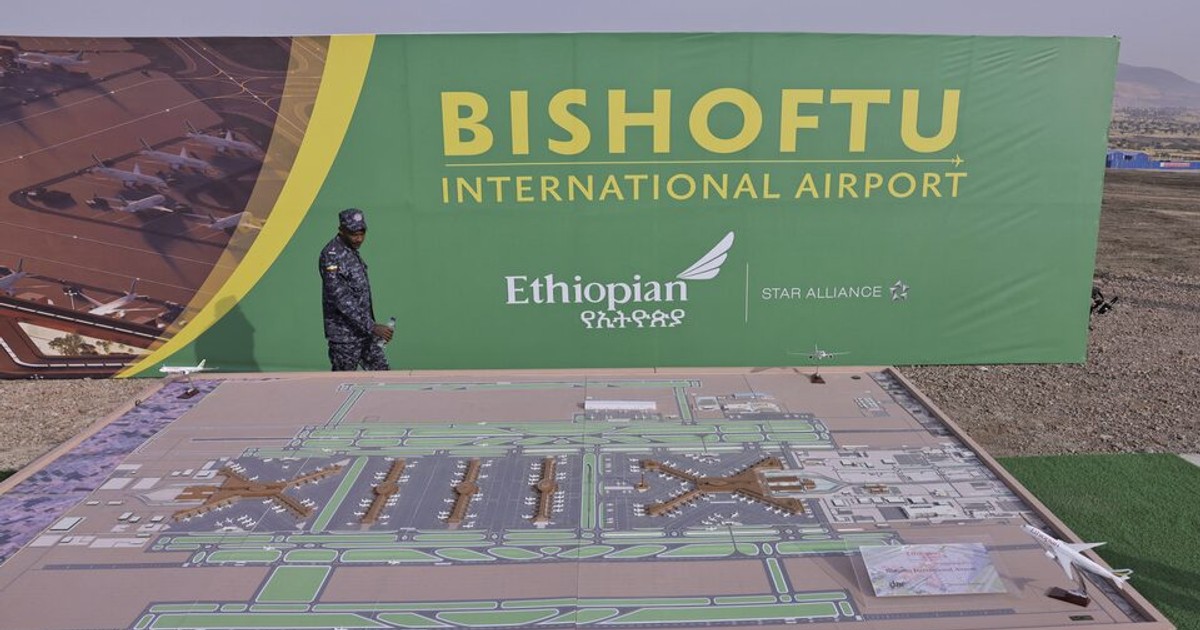
Construction of the four-runway Bishoftu International Airport began in January, about 45 kilometres southeast of Addis Ababa. Scheduled for completion in 2030, the airport is designed to handle up to 110 million passengers annually, making it one of the world’s largest aviation hubs.
Ethiopian officials have repeatedly described the project as their ambition to create the “Dubai of Africa,” transforming the country into a global aviation and logistics gateway connecting Africa, Europe, Asia and the Middle East.
The airport is expected to ease pressure on Addis Ababa Bole International Airport, which has struggled to keep pace with the rapid expansion of Ethiopian Airlines, Africa’s largest carrier by fleet size, destinations and passenger traffic.
Financing the project has also attracted global attention. The African Development Bank has pledged $500 million and is leading efforts to raise $8.7 billion for the development, while Ethiopian Airlines Chief Executive Mesfin Tasew has previously said U.S. financial institutions have expressed interest in supporting the project.
Beyond aviation, Washington is also looking to deepen cooperation with Ethiopia’s Artificial Intelligence Institute as part of a broader strategy to promote American artificial intelligence technologies and digital infrastructure across Africa.
The developments underscore how major infrastructure projects are increasingly becoming arenas for strategic competition between global powers.
While China has historically dominated large-scale infrastructure financing and construction across Africa under its Belt and Road Initiative, the United States is stepping up efforts to secure commercial opportunities in sectors ranging from aviation and logistics to advanced technology.
For Ethiopia, the heightened interest offers an opportunity to diversify its pool of international partners while advancing one of the continent’s most ambitious infrastructure projects. For Washington and Beijing, however, Bishoftu represents far more than an airport—it is a gateway to influence in Africa’s fast-growing aviation, logistics and technology sectors.
